Saturday, 4 January 2014

Spinach-Cheese Triangles

animation thanks for Google+
This ia another one of those family favourites that I didn't really miss until I moved out. Then I had to learn how to make them on my own. I'll describe the ingredients first, then the process -- as seen in the animation  -- which seems daunting until you do it for the first time.

First you need to buy some phyllo/filo pastry, and thaw it if its frozen. Although some supermarkets carry it, I'd buy it from a Middle Eastern shop.  In Edinburgh, we usually go to Maqbouls near the central mosque. It never tastes quite as good as I remember, but most of the brands are okay.  Lately we've been buying 'Theos' which is made in the UK, or some Turkish made versions. Then you need a good sized block of butter - most recipes call for unsalted.  Make sure you also have a good pastry brush - not one that will lose bristles, or that's been used for bbq sauce. And a sharp knife. And a ramekin or glass measuring cup that can go in the microwave oven. Melt a good chunk of the better, and keep it ready. And make sure you have a clean baking tray ready. 

My mother usually makes the filling with a combination of feta cheese and cottage cheese, but I now usually use the cartons of white cheese that are sold in halaal shops for the Middle Eastern market - mostly made in Denmark or Germany.  The other main ingredient is spinach  -- I use frozen spinach that has been thawed and drained.  You can also steam or microwave fresh spinach, or saute it with onions. If it is whole spinach (fresh or frozen), make saure you chop it roughly. Either way make sure you squeeze all the excess liquid out.  To the cheese, I add a small grated onion (or half), and an egg and some pepper.  Some recipes call for nutmeg, but I don't think that's very authentic.   Mix all these together with a fork. Proportions really don't matter too much, as long as its not too liquidy (pour off any excess). 

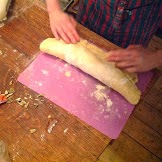
So, now to the assembling.  Take the filo out of the cardboard packaging and cut one section off - about 2.5 inches wide. Leave the rest in the plastic for now.  Then carefully separate one strip of the pastry and lay it out at full length (as in the picture below).  Make sure your hands and worksurface are dry. Immediately brush the strip of pastry with butter, then put a small spoonful of filling in the very bottom corner.  The fold it into triangles.  This is the bit that looks hard, but really is easy (see the video below).


After you've folded one strip up, brush its top with butter and pop it onto the baking tray. Then move quickly back to the pastry and repeat until you have a full tray to bake.  They should bake in an oven around 200C, in about 10-12 minutes.  They're done when they're golden brown. Let cool a little and eat. They freeze beautifully if you have any leftover.  The one crucial thing to remember is to never let the pastry dry out - it will just crack into little bits. So you have to work quickly.  But once you've done it, you'll see how easy it really is. And, after that, you can experiment with fillings. My mother used to make an amazing version with various sorts of grated cheese, but we usually go for spinach, since the kids love them and it gets them an extra vegetable portion!

Update: had a request for a pic of the final product, but can't find one (we ate them).  But, I did find this handy video, which I've uploaded to youtube.

Monday, 30 December 2013

Cranberry-Orange Relish


Although it was a staple of our holiday table, when I was a child, I didn't much care for Cranberry-Orange Relish, preferring partridgeberry jelly (aka low-bush cranberry, lingonsylt, preiselbeeren). 

As an adult though, I've come to love the tart contrast with roast turkey and game. It was always a production to make - my mother would get out our old-fashioned food-grinder that was screwed on to the table top, and the whole family would join in the hard work.  

Just after I moved to the UK, Delia introduced cranberries over here, but everyone seemed to make jelly, which I find bland. Luckily, with cranberries now available in the shops, I was able to reinvent the family relish, despite not having the food-grinder. 


It turns out that any sort of food-processor works just fine. For years, we used our immersion blender, but we now have a mini food-processor.  The recipe is very simple - one bag cranberries (fresh or frozen) - pick over and take out any that are brown or very wrinkled. The proportions are rough, so don't worry too much about the size of bag.  One average sized orange, washed and roughly chopped (peel, pith and all).  In small batches, blend the cranberries and orange together until well chopped, but not pureed.  


Then add 1 cup (200 gr) granulated or caster sugar (in volume terms, this is about 1 part sugar to two parts cranberries).  Mix well, and let sit to macerate, then refrigerate. 

Ideally, this is made a few days before it it needed to let the flavours blend, but at a pinch, even just a couple of hours will do. 


Sour Cherry Stollen


Another Dan Lepard classic here. I've not changed much, except that I soak the cherries in aquavit or sacred gin (which is flavoured with botanicals, not juniper), and then use that to libate the loaf when it comes out of the oven. 
100g unsalted butter
125g caster sugar
Finely grated zest of an orange
½ tsp each ground cardamom, cinnamon and cloves
½ tsp salt
1 medium egg
150g quark cheese
325g plain flour
1 tsp baking powder
50g ground almonds
150g sour cherries
200g marzipan
Rum (or other booze), melted butter and icing sugar

Beat the butter, sugar, zest, spices and salt until smooth, then beat in the egg and quark. Add the flour, baking powder, almonds and cherries, and mix to a soft, even dough. On a floured worktop, pat out to an oval roughly 20cm long x 15cm deep. Roll the marzipan 18cm long, and lay in the centre of the dough. Fold the dough in half and seal with water. Place on a tray lined with nonstick baking paper, and bake at 190C (170C fan-assisted)/375F/gas mark 5 for 40 minutes, until just golden and baked when a skewer is poked in. As soon as it's out, brush first with rum and then lots of melted butter. Once cold, brush with more butter, and dredge heavily with icing sugar. Wrap well and leave to mature for a week


Christmas pudding

This is my version of a Dan Lepard recipe that appeared in the newspaper the week after my daughter was born - Stir up Sunday as it is called in England. We'd never made a christmas pudding before, but it has now become family tradition.  It's ideally suited to being at home with a baby because you just add all the ingredients gradually to a big bowl, then steam for ages - as long as you don't need to go out, you're fine.  Nowadays I usually steam it in a slow cooker overnight, but above is a picture of last year's pudding on the stove top.

200g raisins
150g candied fruit peel 
50 g dried or candied cherries
75g beef suet
200g dark brown muscovado sugar
100g treacle
125g brown bread crumbs
50g plain white flour
½ tsp baking powder
1 tsp cinnamon
1/2tsp ground cloves
1/2 tsp ground allspice
1 tsp grated nutmeg 
2 eggs, beaten
50g grated carrot (about one medium carrot) 
Zest and juice of an orange
125ml dark ale

After mixing all the ingredients together, simply spoon into a buttered pudding basin, cover with parchment and foil, tie string around (or just use a plastic basin with lid), and steam for 4 hours, or over night in a slow cooker. The original recipe called for the wrong size bowl, and we've never figure out what size it is supposed to be.  We usually make either two large puddings or 3 small ones. 

Never having made a pudding before, the whole pudding basin, foil and string thing is definitely the worst bit for me - and worrying that I've done something wring and it will go mouldy. But every year it turns out just fine.  A very forgiving cooking style.


Dad's Oat Pancakes


My Dad took up baking after he retired. This is probably his best recipe - no idea where he found it. But we make it a lot (and can never find the recipe, which is why I'm posting it here).

It can be halved (use 2 eggs), or freeze leftover pancakes between small sheets of grease proof paper / baking parchment, and toast to reheat.  The oats gives them more substance than most recipes and keeps them moist for re-heating.

This is the recipe pretty much as he gave it to me (caps and all). One of these days I'll try to get the ingredients translated into weights for the UK cooks. Update! The ever-amazing Alli Coyle suggests the following weights/metric volume for you to try (slightly adjusted by me).  Thanks Alli!

OAT PANCAKES

1 1/2 CUPS porridge OATS 150g
2 CUPS MILK 500ml
1 CUP FLOUR (WHITE OR WHOLE WHEAT) 125g
2 TBSP BROWN SUGAR (OR WHITE)
2 TSP BAKING POWDER
3/4 TSP SALT (LESS)
3 EGGS
1/4 CUP OIL 60ml
----------------------------------------------------
Mix oats and milk in a small bowl; set aside for about 5 minutes.
Combine flour, sugar, baking powder and salt in a mixing bowl. Blend well.
Add eggs and oil to oats. Beat well.
Combine all and beat well,
Pour by 1/4 cupfuls on to heated griddle, cook and turn after bubbles have formed. (Make sure griddle is hot before starting.)
Makes about 18 pancakes. 

Monday, 25 November 2013

And now for something completely different...

The third of our family birthdays last week was graced with a cake that I've only been making for only a little over a year.  It's a classic from our adopted home - Victoria Sponge. I use Delia's recipe, which is very simple, and always seems to work well.  The layers seem thin before they're baked, but once put together they're lavish.


This time, I poked holes in one of the layers with a wooden skewer, before slathering it with most of a jar of (runny) home-made strawberry jam, and then a layer of plain whipped cream, and topped with just a light dusting of icing sugar..

It's even better in the summer with fresh sliced strawberries and whipped cream.  In this version, I'll add a spoonful of sugar and a few drops of vanilla to the cream.

Thursday, 21 November 2013

Birthday cake - a family recipe


Sometimes the simplest things are the still the best.  This is the cake that we always had for birthdays as children, and now I make it too.  I'm pretty sure the recipe is from my great-grandmother, so that makes 5 generations of our family that have enjoyed it.

It's a very basic cocoa-based cake.   It probably could be made into layers, but we always baked it in a square time and iced it still in the tin.  

Chocolate Cake
8"x8" pan
1/3 cup cocoa
1/3 cup butter or shortening  (80g)
1/2 cup boiling water
1 cup sugar (200g)
1/2 cup buttermilk or yogurt or sour milk
1 cup flour (120g)
1 rounded tsp baking soda
1 egg
1 tsp vanilla
1/2 tsp salt
Put cocoa, butter, water in saucepan and bring to boil. Cook until it thickens.
Pour chocolate mixture into bowl.  Stir in remaining ingredients in order listed. Beat hard for 2-3 minutes.  Pour into greased and floured pan. Bake in 350 deg. oven for 35-40 minutes